Golden Sella vs White Sella Basmati — Which Should You Buy and Why?
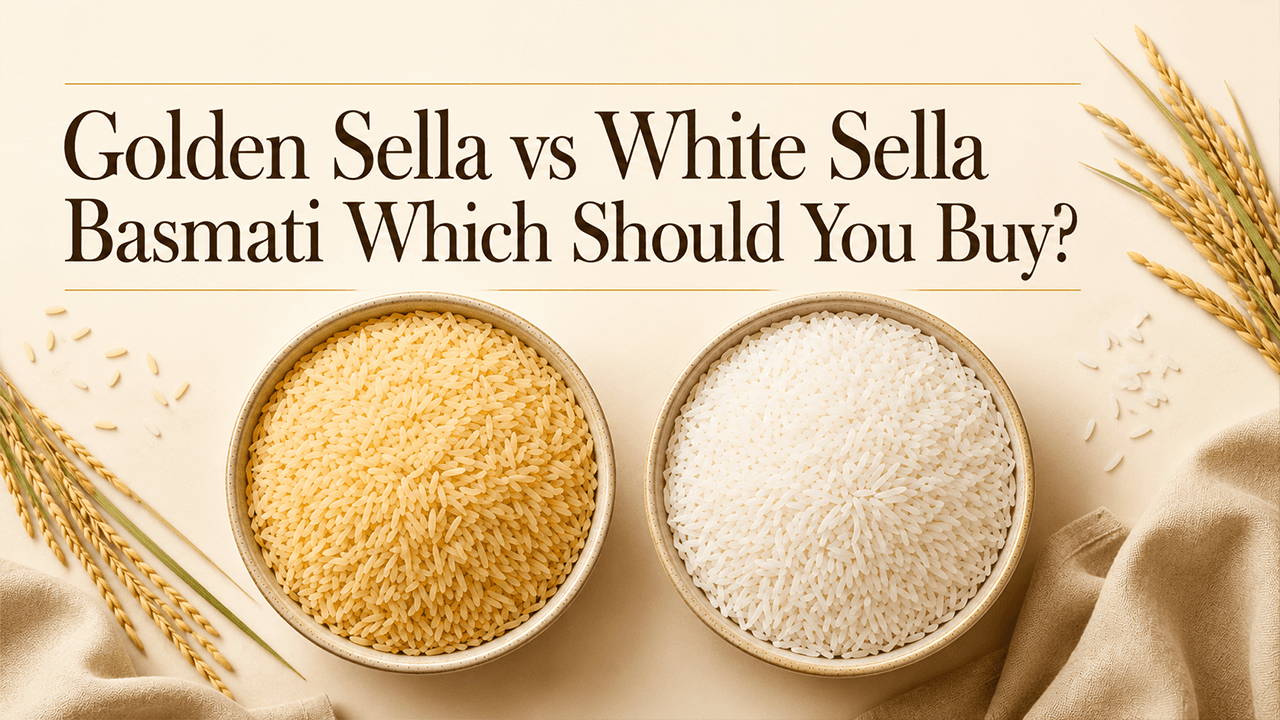
Both are Basmati. Both go through the same milling process. But Golden Sella and White Sella Basmati cook differently, taste differently, and suit different purposes. The choice between them is not a quality decision — it is a use-case decision. Here is how to make it correctly.
What Is Parboiling and How Does It Change Rice?
The difference between Golden Sella and regular white Basmati lies in one process: parboiling. Before milling, Sella (parboiled) Basmati goes through a process where the paddy — still in its husk — is soaked in water, steam-pressured, and dried. This forces the nutrients from the outer bran layer into the grain's interior and partially gelatinises the starch.
The effect on the grain is significant. The starch structure becomes firmer and more resistant to overcooking. The colour shifts from white to a pale golden yellow — which is where Golden Sella gets its name. The texture of the cooked grain is firmer and more separate than non-parboiled white Basmati.
White Sella, by contrast, goes through a lighter parboiling process that results in a near-white grain rather than the distinctive golden colour. White Sella sits between Golden Sella and regular white Basmati in terms of firmness and overcook resistance.
The Nutritional Difference
Parboiling drives B vitamins — particularly thiamine, riboflavin, and niacin — from the outer bran layer into the grain's interior. When the bran is removed during milling, these nutrients are retained in the grain rather than lost with the husk. This makes parboiled Basmati nutritionally superior to white Basmati in B vitamin content.
The glycaemic index (GI) of parboiled Basmati is also lower than white Basmati. The starch gelatinisation during parboiling results in slower glucose release after consumption, which is a relevant consideration for buyers managing blood sugar levels.
Why Golden Sella Does Not Overcook
The most commercially important property of Golden Sella Basmati is its resistance to overcooking. Standard white Basmati becomes mushy if cooked for too long or if held at temperature after cooking — which is why large-scale caterers, hotels, and restaurant kitchens almost universally prefer Sella varieties.
The partial starch gelatinisation that occurs during parboiling creates a firmer cell structure in the cooked grain. Even if the rice is cooked 20 to 30 percent longer than optimal, Golden Sella grains remain separate and retain their shape. This is not a small advantage in commercial kitchen settings where large batches are cooked and held for service.
| Property | Golden Sella Basmati | White Sella Basmati | Regular White Basmati |
|---|---|---|---|
| Colour (raw) | Golden yellow | Near-white | Bright white |
| Overcook resistance | High | Medium-high | Low |
| B vitamin content | High (retained) | Medium-high | Lower (lost in bran) |
| Glycaemic index | Lower | Medium | Higher |
| Texture when cooked | Firm and separate | Slightly firm | Soft and fluffy |
| Best for | Catering · Biryani · Bulk cooking · Pulao | Everyday cooking · Restaurants | Home cooking · Dum biryani |
When to Use Golden Sella vs White Basmati
Choose Golden Sella when:
- Cooking large volumes for events, weddings, or commercial service
- The rice will be held at temperature for more than 30 minutes before serving
- Cooking biryani or pulao where grain separation and structure are critical
- The cook controls timing less precisely — catering kitchens, large household events
- A firmer texture is preferred in the finished dish
Choose White Basmati when:
- Cooking at home with precise timing and immediate serving
- A softer, fluffier grain texture is preferred
- Cooking for dum biryani where the grain's natural starch properties contribute to the layering process
- Preparing dal chawal or simple rice dishes where textural firmness is not the priority
Why Caterers and Hotels Prefer Golden Sella for Large-Volume Cooking
The catering industry's preference for Golden Sella Basmati is well established and has a straightforward economic logic. When cooking for 200 people, the rice must be ready in one or two large batches, served over a period of one to two hours, and held at temperature throughout service. White Basmati under these conditions becomes progressively softer and begins to stick together within 30 to 45 minutes of cooking.
Golden Sella under the same conditions — held for up to two hours — remains separate and retains its texture significantly better. This is not a marginal difference. It is the difference between rice that looks and eats well throughout a service period and rice that requires continuous small-batch cooking to maintain quality.
For home cooks preparing large quantities for weddings, festivals, or family events, the same logic applies at a smaller scale. Golden Sella forgives timing imprecision in a way that white Basmati does not.
Double Chabi Golden No.1 — What Sets It Apart
Double Chabi Golden No.1 Sella Basmati uses the same 1121 grain variety as the company's white Basmati range — meaning the base grain has the same elongation potential and aroma characteristics — processed through the parboiling method to produce the Golden Sella finish.
The 1121 variety's naturally high amylose content makes it particularly well-suited to the parboiling process. The resulting grain has exceptional overcook resistance combined with the elongation and aroma that 1121 is known for — a combination not all Sella varieties achieve, since shorter-grain varieties parboil to a product that is firm but lacks the length and fragrance of premium Basmati.
Double Chabi Golden No.1 is available in 5kg, 10kg, 25kg, and 30kg packs through doublechabirice.com.
Frequently Asked Questions
- What is the difference between golden sella and white Basmati rice?
- Golden Sella Basmati is parboiled before milling — a process where the paddy is steam-treated to drive nutrients into the grain and firm the starch structure. This results in a golden colour, firmer texture, better overcook resistance, and higher B vitamin content compared to white Basmati, which is milled without parboiling.
- Why is golden sella rice yellow?
- The golden colour comes from the parboiling process. During parboiling, natural pigments from the bran layer migrate into the grain along with the nutrients. The yellow tone indicates the rice has been properly parboiled — it is not an additive or artificial colour.
- Is golden sella rice better than white Basmati?
- Neither is objectively better — they suit different purposes. Golden Sella is better for large-volume cooking, catering, and situations where the rice will be held at temperature after cooking. White Basmati is better for home cooking with immediate serving and for dishes where a softer, fluffier grain is preferred.
- Can I use golden sella for biryani?
- Yes. Golden Sella is excellent for biryani, particularly for large quantities. Its overcook resistance means the grains remain separate even through the dum process. Many professional biryani chefs prefer Golden Sella for large batches precisely for this reason.